
The Two Things We Do With Hard Feelings at Work (And the Third Option Nobody Taught Us)
Mar 19, 2026
A few years ago, I was facilitating a session at a law firm, and I asked a room full of attorneys a question that seemed simple:
"What do you do when you have a strong emotional reaction at work?"
The answers came fast.
"I push through it." "I go to the bathroom and take a breath." "I vent to my spouse at 9:00 p.m." "Honestly? I just ignore it and move on."
One partner laughed and said, "I send an email I regret, and then I spend the rest of the day wishing I hadn't."
Everyone laughed. Because everyone had been there.
The Two Defaults
In my experience working with legal professionals, most of us handle difficult emotions in one of two ways.
We suppress. We push it down, put on a calm face, and keep going. We tell ourselves we'll deal with it later. Later usually means never, or it means the feeling leaks out sideways. Shorter patience with a colleague. A sharper tone with a family member. A glass of wine that turns into three.
Or we spiral. We replay the conversation in our heads. We draft the response we'll never send. We build a case against the person who upset us, complete with evidence and closing arguments. (Lawyers are especially good at this one.) The original frustration grows into something much bigger than the moment that caused it.
Both of these are completely natural responses. And neither one actually helps.
Suppressing doesn't make the feeling go away. It just stores it somewhere in your body until it finds another exit. And spiraling doesn't resolve anything. It just keeps the emotional intensity going long after the original moment has passed.
What Nobody Taught Us
Here's what I wish someone had told me early in my career: there's a space between pushing a feeling away and getting lost in it.
It sounds simple, and it is. But simple doesn't mean easy, especially in a profession that trains us to think our way through everything.
Emotions aren't problems to solve. They're information. They're your body telling you something: that a boundary was crossed, that something matters to you, that you're carrying more than you realized.
When we treat them as inconveniences to manage or threats to contain, we miss the message. And we spend a lot of energy fighting something that was actually trying to help us.
The Middle Path
So what does that space between suppressing and spiraling actually look like in practice?
It looks like noticing. Not analyzing, not judging, not fixing. Just noticing.
It might sound like: "I'm frustrated right now." That's it. Not "I'm frustrated because she always does this and it's completely unreasonable and I can't believe I have to work with someone who…"
Just: I'm frustrated right now.
Research in neuroscience and psychology calls this "affect labeling," and it consistently shows that simply naming an emotion reduces its intensity. When you put language to what you're feeling, you activate the part of your brain that helps regulate emotional responses. You create a small gap between the feeling and your reaction to it.
And in that gap? That's where you get to choose.
You can choose to respond instead of react. To wait instead of sending. To ask a question instead of making an accusation. To take five minutes before you walk into the next meeting carrying the energy of the last one.
A Tool to Help You Name What You're Feeling
One of the things that makes affect labeling hard is that most of us have a pretty limited emotional vocabulary. We default to "fine," "stressed," or "frustrated" because those are the words we reach for. But emotions are much more nuanced than that, and the more precisely you can name what you're feeling, the more effectively you can work with it.
That's why I love the Feelings Wheel, originally created by Dr. Gloria Wilcox. It starts with broad emotional categories at the center and expands outward into increasingly specific feelings. Instead of "I'm angry," you might discover you're actually disappointed, or disrespected, or overwhelmed. Each of those calls for a different response.
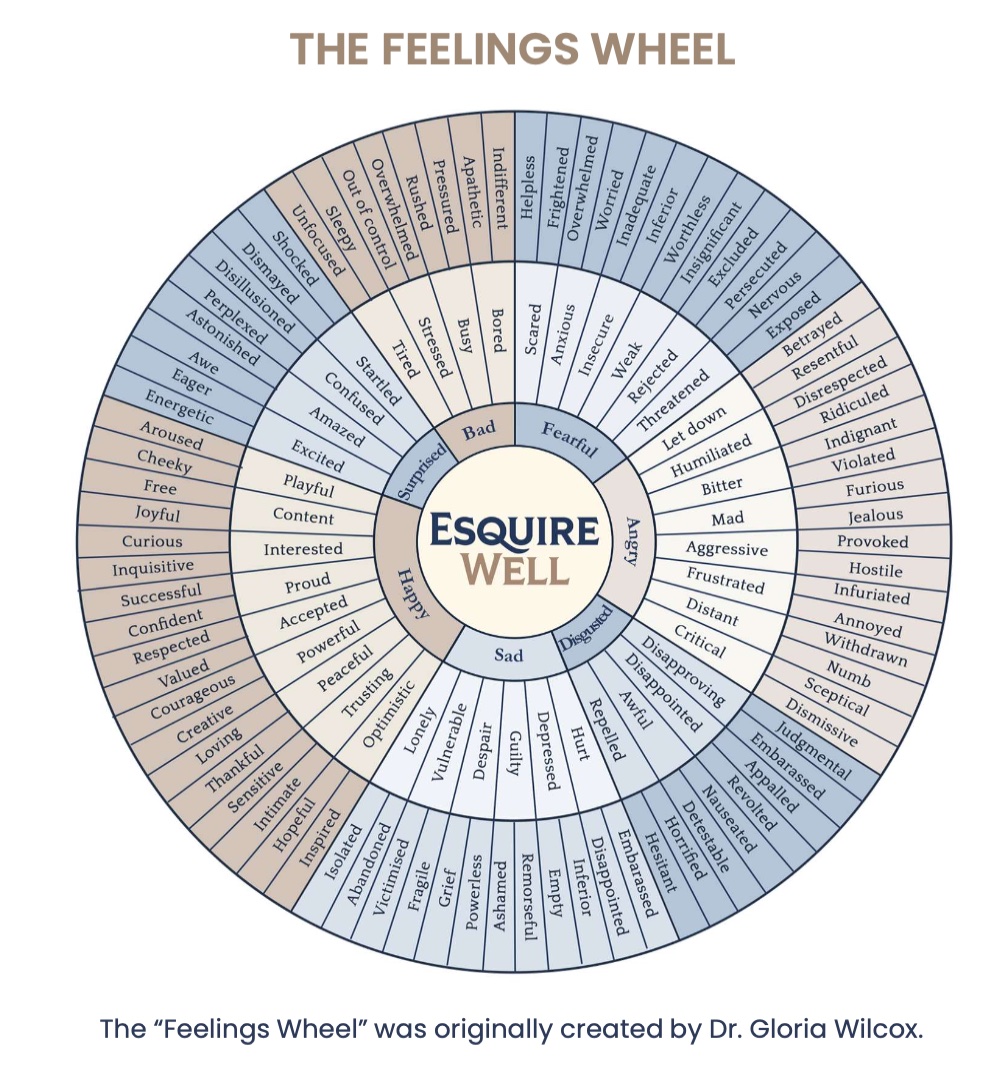 The EsquireWell Feelings Wheel
Keep it at your desk, share it with your team, or use it as a starting point the next time you pause to check in with yourself.
Download the Feelings Wheel (PDF) →Starting Small
You don't have to become a meditation expert or an emotional intelligence guru to practice this. You just have to start noticing.
Next time you feel your chest tighten, your jaw clench, or your stomach drop, try pausing for a moment and naming what's there. Not out loud if that feels weird. Just to yourself.
Frustrated. Anxious. Disappointed. Overwhelmed. Sad.
These aren't weaknesses. They're data. And learning to read that data clearly is one of the most valuable professional skills you can develop. It's actually the foundation of what we teach in our Keeping Your Cool: Emotional Regulation for Resilience and Results in the Legal Profession program, helping legal professionals build the capacity to notice what they're feeling, name it, and respond from a steadier place instead of reacting from a triggered one.
You might be surprised how much changes when you just give the feeling a name instead of a reaction.
And if you want to take it one step further: notice what happens in the minutes after you name it. Most of the time, the intensity softens on its own. Not because you did anything heroic. But because you let it be what it was instead of turning it into something bigger.
It's a Practice, Not a Performance
I want to be honest. I don't get this right every time. There are still days when I fire off a message too fast or carry tension from one conversation into the next.
But the days when I do pause, even briefly, feel different. Not because the hard stuff disappears, but because I'm not adding to it.
And over time, that adds up to something that matters: more clarity, more steadiness, and a lot less energy spent cleaning up reactions I wish I'd handled differently.
Your emotions aren't the problem. They never were. The only question is whether you let them drive, or whether you learn to sit with them long enough to take the wheel yourself.
Every week, I explore ideas like this in the EsquireWell Weekly — practical reflections on well-being, emotional intelligence, and showing up with more clarity in demanding work. It's free, it's personal, and subscribers tell me it's the one newsletter they actually look forward to.