
Don't Silence Your Inner Critic. Talk to It.
May 21, 2026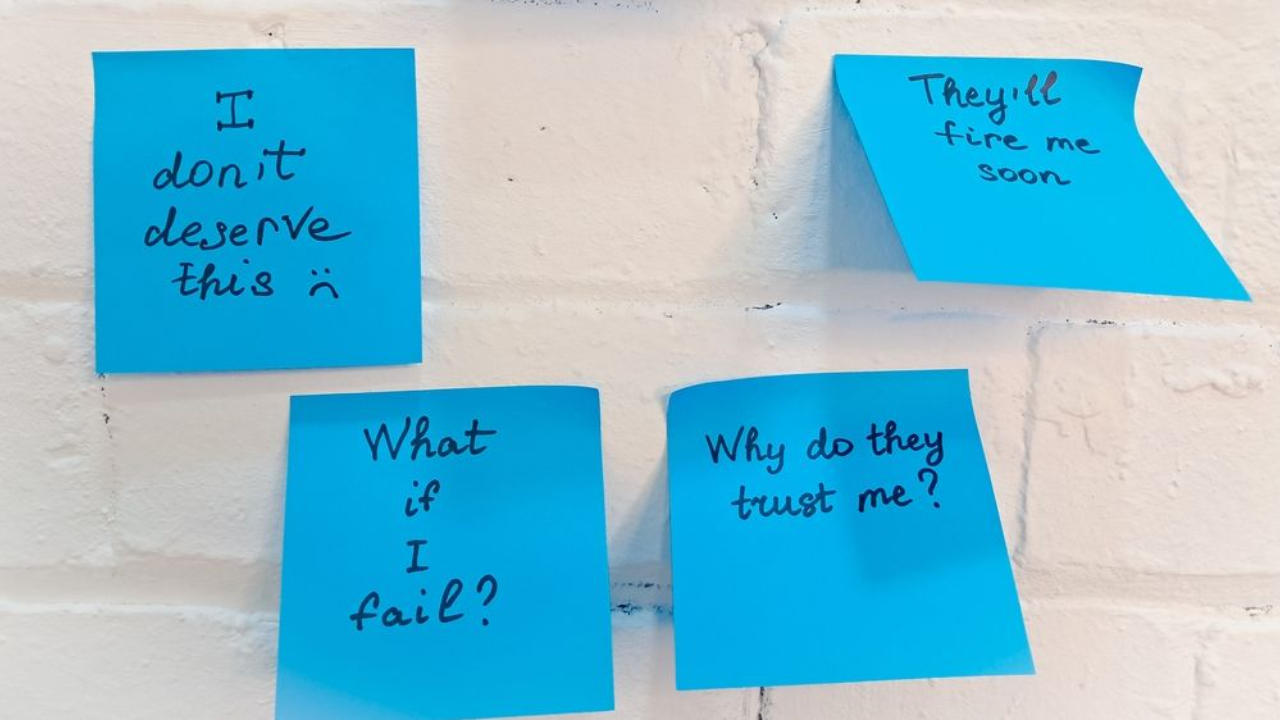
For years, the standard advice on imposter syndrome has been a version of the same message: silence your inner critic, push past self-doubt, "fake it until you make it."
If you've tried this approach, you already know how well it works, which is to say, not very well at all.
Ron Carucci, writing in Harvard Business Review, puts it bluntly: when we try to silence our inner critic and fail, we don't just experience the original self-doubt. We feel ashamed of being self-critical in the first place. What starts as a confidence problem becomes a shame spiral, and the attempt to fix it only makes it worse.
For legal professionals, this hits close to home. The profession selects for high achievers, rewards exactness and visible competence, and creates ideal conditions for imposter syndrome to take root. The gap between "how confident I appear" and "how confident I actually feel" is enormous for many lawyers, regardless of their level of seniority.
According to the research, the better approach isn't silencing the critic at all. It's learning how to have a conversation with it.
Why Imposter Syndrome Shows Up So Often in Law
Legal training is adversarial from day one. The model is built around challenging your thinking, exposing weaknesses in your reasoning, and testing whether your arguments hold under pressure. This builds sharp analytical skills, but it also embeds an early lesson: uncertainty is dangerous, and being wrong carries real consequences.
The professional culture reinforces that lesson. Clients expect confident advice. Colleagues expect polished work product. The market rewards people who seem to have all the answers. In that environment, admitting that you feel uncertain or that you might not belong feels like a professional risk most people aren't willing to take.
What makes imposter syndrome especially persistent is that it doesn't fade with experience. A junior associate worries about getting a research memo right. A senior associate worries about managing a client relationship. A partner of 15 years sometimes wonders whether they truly earned their seat. The feeling scales with responsibility, and seniority provides no immunity.
Why the "Silence It" Approach Backfires
Carucci's work explains why suppressing an internal voice doesn't make it go away. It actually makes it louder. When the voice inevitably returns, the person now has two problems. The first self-doubt is still there, and now there's an added layer of shame for failing to manage it.
Psychologists call this a "thought suppression rebound." The harder you try not to think about something, the more persistent the thought becomes. For legal professionals who are already wired for analytical rumination, this pattern can become especially difficult to interrupt.
What It Looks Like to Actually Talk to Your Inner Critic
The alternative doesn't mean accepting everything your inner critic says at face value. It means developing enough of a relationship with that voice to evaluate what it's telling you rather than just reacting to it.
Trace the origin story. Your inner critic developed from specific experiences and messages you absorbed early in your career or even earlier. A partner who still hears traces of a harsh law professor from two decades ago may be reacting to feedback that has long since become irrelevant.
Separate the signal from the noise. Your inner critic isn't always wrong. Sometimes it's flagging a genuine gap or a situation where you're stretched beyond your current experience. The real skill is learning to ask: "Is there something particular I should do differently here, or is this just anxiety?"
Reframe criticism as a hypothesis. When your inner critic says, "You're going to fail at this," try treating it as a hypothesis you can test. What evidence supports it? What contradicts it? What would you need to do to succeed? This takes the emotional intensity out of the thought and turns it into something actionable.
Respond with open-mindedness instead of combat. Rather than trying to shut the voice down, ask it: "What exactly are you worried about?" The voice tends to soften when it feels acknowledged, which is how most people work, too.
Give it a name. Externalizing the voice by giving it a name or a character creates real psychological distance. "That's my imposter talking" is a very different internal experience than "I'm not good enough." The first one is an observation you can evaluate. The second one feels like the truth.
What Organizations Can Do
Addressing imposter syndrome at the organizational level starts with making the conversation normal.
Talk about it in real terms. When a senior leader mentions in a mentoring conversation that they still get nervous before a big pitch, it changes the dynamic for the junior lawyer sitting across from them. Small, honest admissions from credible people carry enormous weight.
Build development conversations around strengths, not just gaps. When reviews focus exclusively on what someone needs to improve, they feed the imposter narrative. Conversations that also name specific strengths and describe real impact give people a more accurate picture of their professional identity.
Create mentoring relationships where honesty is welcome. Imposter syndrome gets its power from isolation. It loses that power when someone says, "I feel like I don't belong here," and hears back, "I've felt that way too, and here's what helped me."
Pay attention to the overworkers. The people most affected by imposter syndrome frequently look like the most successful people in the room. They compensate through relentless effort and a refusal to ask for help. These are often the last people anyone thinks to check in on, and they're often the ones who need it most.
The Bottom Line
Your inner critic isn't going anywhere. Trying to silence it tends to leave you feeling worse than when you started.
Learning to talk to it is a more productive path. Understand where it comes from. Evaluate whether what it's saying has any basis in reality. Respond with genuine curiosity as opposed to trying to win an argument with yourself.
The voice that tells you "you don't belong here" is almost certainly wrong about that. But fighting with it hasn't worked so far. Listening to it, evaluating what it actually has to say, and choosing your own response are much better uses of your energy.
Every week, I explore ideas like this in the EsquireWell Weekly — practical reflections on well-being, emotional intelligence, and showing up with more clarity in demanding work. It's free, it's personal, and subscribers tell me it's the one newsletter they actually look forward to.